
A pearl by any other name – our guide to the world of pearls

Rachel Warner FGA DGA
|
5 August 2026
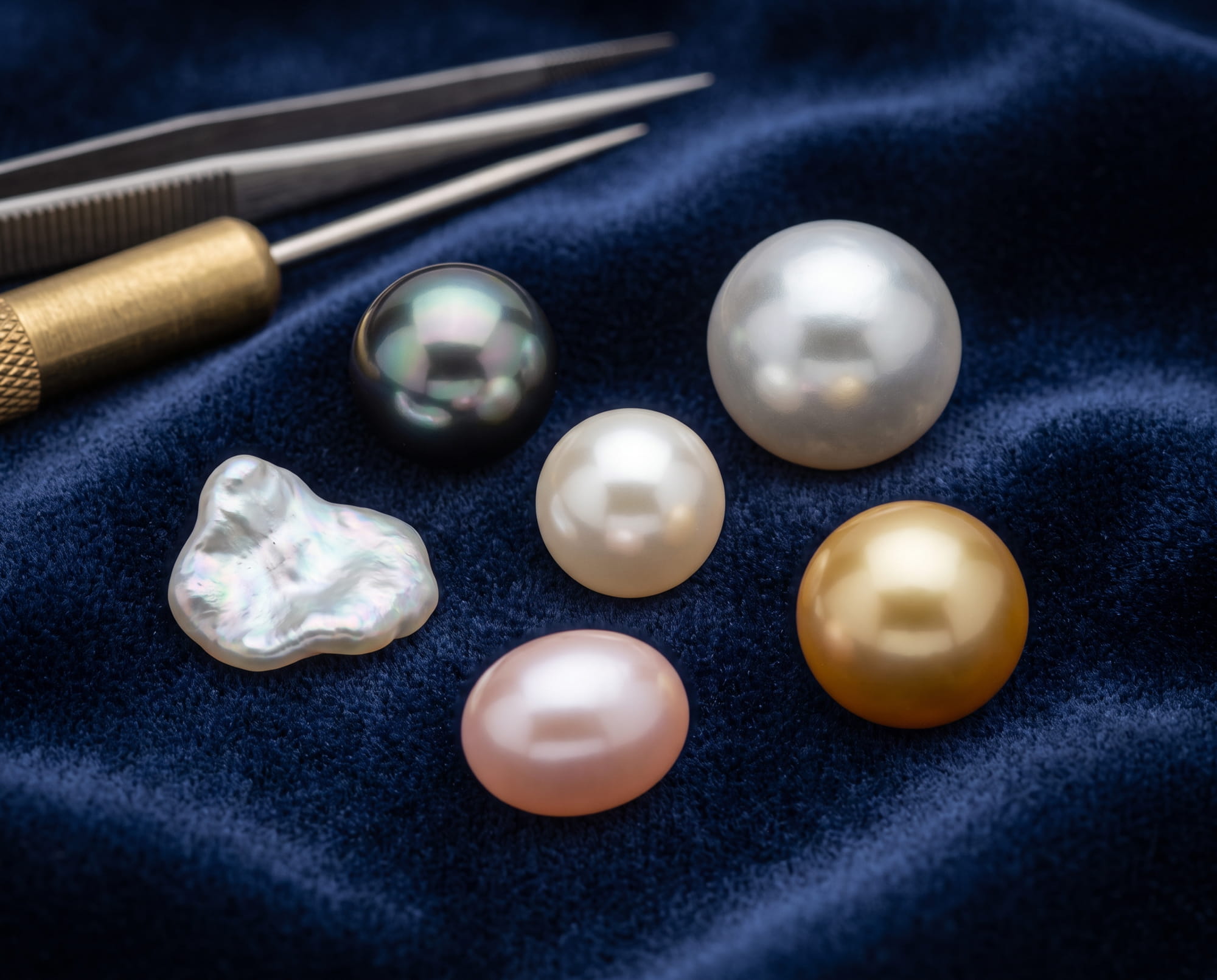
Pearls have been valued for centuries for their luminous beauty and rarity. From Cleopatra to Timothée Chalamet, these water-born treasures have attracted the attention and admiration of men and women alike.
Today, the term ‘pearl’ is used to refer to a wide variety of different types, each with their own characteristics and origins. Understanding the differences between the members of this family goes beyond the simple distinction between natural and cultured or freshwater and saltwater. So here is our (hopefully!) helpful guide to the world of pearls and the words we use to describe them.
Natural Pearl
The term ‘natural pearl’ is used to refer to any pearl formed inside a wild mollusc by an entirely natural process and without any sort of human intervention. Pearl producing molluscs include oysters, mussels and some gastropods (sea snails) such as abalone and the queen conch. For more details on why and how a natural pearl forms, have a read of our post A Beautiful Accident.
Cultured Pearl
A cultured pearl is one that forms inside a farmed oyster or mussel due to the human implantation of a bead and/or piece of mantle tissue from another mollusc. There are two different types of cultured pearl – beaded and non-beaded. These terms refer to the method of artificially instigating the mollusc to make a pearl. A beaded cultured pearl is made by surgically inserting a spherical polished shell bead into an oyster along with a small piece of mantle tissue from a donor oyster. A non-beaded cultured pearl uses only the mantle tissue without a bead and is more commonly seen in the culturing of pearls grown in freshwater mussels rather than saltwater oysters.
Imitation Pearl
These are not actually pearls at all but rather beads formed of plastic, glass or ground shell that have been given a coating of an artificial pearlescent varnish-like liquid (often containing fish scales) to make them resemble pearls. They imitate the general appearance of pearls without ever having seen the inside of an oyster or mussel.
Saltwater Pearl
A saltwater pearl is one that has grown in a mollusc that lives in salt water, for example a saltwater oyster. They can be either natural or cultured and are sometimes also referred to as ‘marine’ pearls.
Freshwater Pearl
A freshwater pearl is one that has grown in a mollusc that lives in fresh water, for example a freshwater mussel. They can be either natural or cultured.
Akoya Pearl
Akoya pearls are your classic round, creamy-white cultured pearls with top quality examples displaying a deep lustrous glow. They are primarily farmed in Japan and are grown in the saltwater akoya oyster Pinctada fucata martensii. Typically ranging in size from 6
8mm in diameter (although both smaller and larger sizes do occur) they have defined the cultured pearl industry for over a century, setting the standard for cultured pearls of this size and colour.
Tahitian Pearl
Tahitian pearls are known for their grey to black body colour overlaid with a range of beautiful peacock-coloured iridescence. Those commercially available today are almost exclusively cultured and are grown in the black-lipped pearl oyster Pinctada Margaritifera with typical sizes ranging from 8 – 18mm in diameter. Despite the name, Tahiti itself is not a significant pearl producer but it serves as an administrative and commercial centre for the surrounding pearl farms found throughout the balmy waters of the islands and atolls of French Polynesia. Viewed by some as an edgier and more modern alternative to the classic and traditional creamy-white coloured pearls, these darkly coloured pearls are enduringly popular. Today, a fine quality row will set you back thousands of pounds but that seems a snip when compared to the Cowdray Pearl Necklace, an exceptional row of natural Tahitian pearls which sold at Sotheby’s in 2015 for $5.3 million USD.
South Sea Pearl
These pearls range in colour from silvery white through to a deep gold and are grown by the south sea oyster Pinctada Maxima. This oyster has two different varieties, the silver-lipped and the gold-lipped each of which is responsible for producing pearls in a corresponding range of colours.
As its Latin name suggests, this is a particularly large species of oyster which means it is able to take a larger bead implant and to grow that into a pearl over a longer period of time than its smaller relations. South sea pearls are therefore the largest pearls available (8-20mm) and are valued for the thickness of their nacre which develops over the extended growth period and gives these pearls a deep radiant lustre. The waters off north western Australia produce some of the finest white pearls whilst golden pearls come primarily from the waters of the Philippines. Indonesia is another significant commercial source and farms both white and golden coloured pearls. As with the Tahitian pearls, the vast majority of South Sea pearls commercially available today are cultured. The most valuable are the deep golden colour pearls and the finest examples appear lit from within with a sunny luminescence.
Keshi Pearl
The term ‘keshi’ comes from the Japanese word for poppy seed and is used to refer to small pearls that form accidently as a by-product of the culturing process. They most commonly occur when an akoya oyster rejects the bead nucleus but the small piece of implanted mantle tissue remains and causes a pearl sac to form and create a pearl. Typically irregular in shape and small in size they are composed of solid nacre with no bead centre.
Mabé Pearl
A mabé pearl is a round domed cultured pearl composite made by attaching a hemisphere shell nucleus to the inside of an oyster’s shell. When the shell is harvested, the dome shapes are cut out and the nucleus removed. The hollow nacreous dome is then filled with a resinous material which gives it strength and it is then sealed with a mother of pearl backing. These pearls are often used for earrings and brooches where a domed shape with a flat back is more convenient and practical to use than a fully spherical pearl.
Blister Pearl
A blister pearl is one that formed naturally inside a mollusc but rather than developing within the soft tissue of the mollusc’s body, it grew attached to the inside of the shell forming a dome shape. When the oyster is harvested these are cut out of the shell and the backs polished ready for use in jewellery.
Mother-of-Pearl
The term mother-of-pearl is used to describe the beautiful iridescent inner surface of the shell of pearl producing molluscs. Like pearls it is formed of layers of aragonite platelets cemented with conchiolin protein to form a lustrous iridescent nacre. It has been prized for its iridescent beauty for thousands of years and in antiquity was used for inlay work and decorative items as well as jewellery. The 19th century saw a huge boom in demand for the material which was used to make clothing buttons, knife handles, gaming tokens and personal decorative items amongst many other uses.
Mississippi Pearls
As the name suggests, these pearls come from freshwater mussels which live and breed in the Mississippi river system in America. They were naturally formed and became incredibly desirable during the late 19th and early 20th centuries leading to severe over-fishing and dramatically reduced supply. Today they are very rare, with most examples being found in antique jewellery. They occur in a range of colours, sizes and shapes but the best known and most recognisable are the creamy white baroque shaped pearls, often elongated and asymmetric. Jewellers at the turn of the last century used them to create interesting and imaginative jewels such as the famous chrysanthemum flower brooch by Tiffany & Co which utilises the shape of the pearls to represent the individual petals of the flower.
Scottish River Pearls
These are rare natural pearls found in the freshwater mussel Margaritifera Margaritifera that live in the rivers and lakes of the Scottish Highlands, such as the River Tay. They occur in creamy white through to brownish colours and vary in shape and size. Known and revered for centuries, legend has it that one of the reasons Julius Caesar invaded Britain was to access these pearls. They adorn the Crown of Scotland and were a favourite gem of Queen Victoria which led to them becoming highly fashionable during her reign. This huge increase in demand for Scottish pearls led to over-fishing in the region and eventually a significant depletion of the mussel population. Wild pearl fishing was made illegal in Scotland in 1998 in the hope of protecting the remaining mussels and their environment whilst conservation work hopes to encourage an increase in their numbers. Scottish river pearls recently made the news when The Abernethy Pearl, an exceptionally rare and large example, went up for auction. It is a beautiful round creamy-white pearl weighing 43.6 grains and was bought for £93,951 before being donated to the National Museum of Scotland where it is now on display.
Conch Pearl
A conch pearl is a rare natural pearl formed by the Queen conch mollusc, an edible giant sea snail primarily fished for food in the warm waters of the Carribean, Gulf of Mexio and the Bahamas where it is regarded as a national delicacy. They differ from most other types of pearl in that they have no iridescent nacreous surface but are instead identified by their flame-like, watered silk pattern which appears to ripple across the surface. Conch pearls are most commonly thought of as pink in colour but they also occur in orangey and brownish to cream colours. It is the pinks that are the most desirable however and with approximately only one gem quality pearl found per hundred thousand shells, they are some of the rarest pearls in the world. So far, efforts to culture these pearls have proved commercially unsuccessful so for now, conch pearls are the gems of mother nature alone.
Melo Melo Pearl
Like conch pearls, the Melo Melo is another very rare non-nacreous pearl. Predominantly orange in colour with shades ranging from a pale brownish orange through to the most vibrant fiery orange, the flame-like structure can seem particularly pronounced in those that display it. They are formed by the large Melo sea snail which is found in the waters around Southeast Asia and take decades to form. As with the conch pearls, attempts to culture Melo pearls have been unsuccessful meaning all these pearls are natural, a fact that only adds to their allure. They vary in size from just a few millimetres up to 30mm plus in diameter, but these large sizes are incredibly rare, the majority seen on the market are in the 10 to 20mm range. Occasionally seen in the high jewellery created by the top jewellery houses, these pearls are the rarest of the rare and a true collector’s gem.
Coque de Perle
This term refers to a pearl imitation that was particularly popular in jewellery during the 18th century when natural pearls were highly fashionable but also rare and prohibitively expensive. Carved from the most highly domed part of the Indian nautilus shell these oval domed pieces of pearly iridescent shell were filled to stabilise them and then made into earrings, necklaces and bracelets. Usually set in silver with marcasite or cut steel borders and decoration, they are occasionally found set in gold. Pieces sometimes come up at auction or with antique jewellery dealers and there is a lovely example on display in the Victoria and Albert museum.